State of favicon in 2026
Twelve years ago, we looked at the favicon of the Alexa top 100 and found that 40% of the most visited websites had no favicon for mobile platforms. The argument then was simple: when Usain Bolt is on the track, you expect less than ten seconds. When you land on one of the biggest websites in the world, you expect the favicon to be right.
The web has changed since. Alexa is gone. The apple-touch-icon grew from 57 to
180 pixels. SVG favicons became a thing. Google started showing favicons in its
search results. Progressive web apps arrived, brought a manifest with them, and
mostly stopped being talked about.
One thing has not changed: the biggest websites are not better at this than anybody else. They are, in a few measurable ways, slightly worse. That is the finding this survey keeps running into, so it is the thread of this article.
How we measured
We took the Tranco top 5,000 — the research-grade
successor to the Alexa list, combining Chrome CrUX, Cloudflare Radar, Majestic,
Umbrella and Farsight — and analyzed every site with the very engine that powers
our favicon checker. Same code, same rules, no human
judgment in the loop. The crawl ran on September 6, 2026. Icons, manifests and
robots.txt files were fetched again on September 13, after fixes to the
checker.
Of those 5,000 sites, 2,851 could actually be analyzed. The rest did not
answer (1,346), returned an HTTP error (635), served something that was not a
web page (14), or answered with a challenge, consent or geo-blocking page
instead of their home page (154). That 43% is not a bug in our crawler, and it is worth dwelling on for a
second, because it is the first place the top of the ranking misbehaves: the
more visited a site is, the more likely it is to refuse a plain HTTP client.
Only 57 of the top 100 showed us their home page. Facebook replies 400 to a client
that claims to be Chrome without behaving like one — which is exactly what a
crawler looks like. booking.com is subtler: it
answers 202 with a page that carries no title and no favicon markup at all,
which is a wall wearing the costume of a home page. We count those separately
rather than record them as sites without a favicon.
Two more things to keep in mind while reading the numbers. We do not execute
JavaScript, on purpose: what we measure is what a crawler and the first paint
see. And the ranking is not a list of websites — it contains infrastructure
domains with no homepage at all (gstatic.com, akamai.net,
gtld-servers.net), which we keep in the dataset with their real outcome and
exclude from every percentage below.
The favicon is still an ICO file
If you had to describe the favicon of 2026 in one sentence: it is a
favicon.ico, and a third of the time nobody bothered to declare it.
89.7% of the sites we analyzed serve an ICO favicon. 60.9% declare it in the
HTML with a <link> tag, while 28.8% just leave a /favicon.ico file at the
root and let browsers find it the way Internet Explorer taught them to in 1999. It works. It has worked for twenty-seven years. It remains, by a wide
margin, the most deployed favicon technique on the web.
The rest of the family, on the same population:
| Share of the sites we analyzed | |
|---|---|
| ICO favicon | 89.7% |
| Apple touch icon | 53.8% |
| PNG favicon | 46.9% |
| — at 96×96, the size Google asks for | 10.5% |
| Web app manifest | 27.3% |
| — with an icon that actually loads | 21.0% |
| SVG favicon | 13.9% |
| All four families at once | 6.5% |
| No icon declared at all | 2.5% |
Two lines deserve a comment. The SVG favicon at 13.9% is the one modern
practice that has not taken off — every major desktop browser supports
it, it scales to any size, it can
adapt to dark mode, and nearly nine sites
out of ten still do not ship one. And 2.5% of the sites we analyzed — 71 of
them — declare no icon at all: no ICO, no PNG, no SVG, no touch icon, and
nothing at /favicon.ico either. Most are infrastructure (adsrvr.org,
scorecardresearch.com, mmcdn.com), but not all: ietf.org, google.cn,
openssl.org, cpan.org, gzip.org and libpng.org are in that group, and we
re-checked them by hand — their homepage carries no icon markup, and
/favicon.ico answers 404.
Being in the top 100 does not help
Here is the survey's core finding, and the reason the 2014 premise deserved re-testing.
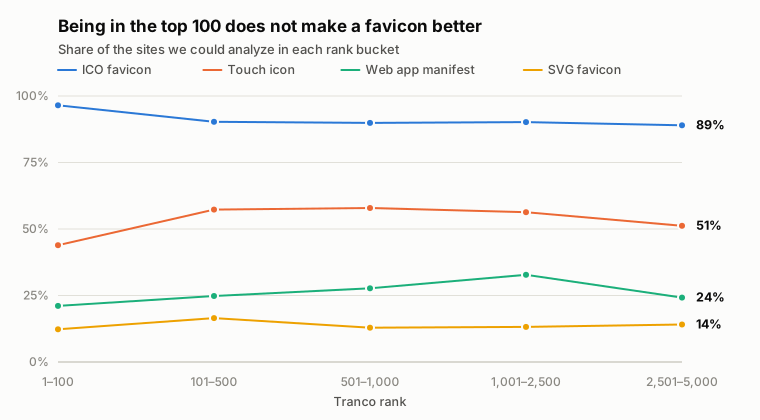
Adoption is flat. From the top 100 down to rank 5,000, the manifest stays between 21.1% and 32.8%, the SVG favicon between 12.3% and 16.5%. Nothing that looks like the quality gradient you would expect between a household name and the four-thousandth site of the web. The one exception is the most basic practice of all: 55 of the 57 top 100 sites we could analyze serve an ICO favicon, 96.5%, against 89.0% to 90.3% everywhere else — in a bucket that small, a handful of sites is the whole difference.
And on the touch icon, the ranking is upside down: the top 100 is the worst bucket of the whole survey at 43.9%, against 57.3% for ranks 101–500 and 56.3% for ranks 1,001–2,500. In 2014 we measured 60% touch icon support in the Alexa top 100. The two figures are not strictly comparable — different ranking, different method, and today's bot walls mean the top 100 only gives us 57 sites to look at — but nobody can claim the top of the web has been pulling ahead.
Why would it be flat? Before blaming anyone, there is a hypothesis to consider. Most major websites have a native app, and the touch icon and the manifest are about one thing: adding the site to the home screen of a phone. If you are even slightly serious about Instagram, you install the app — you certainly do not pin instagram.com to your home screen. For a site in that position, a missing touch icon may not be negligence so much as a platform nobody uses. That would explain the top 100 sitting lowest on the touch icon.
It does not explain the rest, though. A native app does not make the browser tab go away, and the top 100 is no better than anyone else at the SVG favicon. So the likelier answer is simpler: a favicon is nobody's job. It gets set up once, by whoever built the site, and then it survives redesigns, migrations and rebrandings untouched. Audience does not touch that. A billion visitors a month buy a lot of engineers, and not one of them is assigned to the tab icon.
Nobody ever deletes a touch icon
Apple has been asking for 180×180 since the iPhone 6 Plus, in 2014 — a size that, as we checked a while ago, is still the right answer today. 1,013 of the 1,534 sites with a touch icon — 66.0% — declare a 180×180.
That is the easy half of the question. The interesting half is what those sites
declare besides it: 1,534 sites, 3,335 touch icon declarations we could
size. 400 of them declare more than one — a second, a third, sometimes a
ninth <link>, for devices nobody has used in a decade.
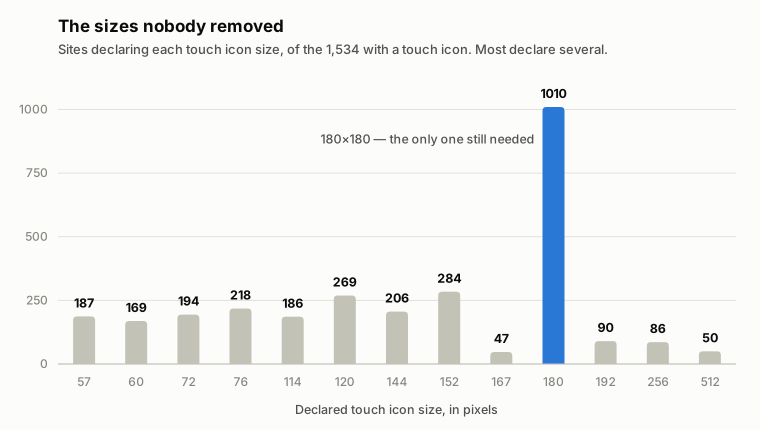
Read that chart the right way: a site appears in every bar it declares, so the columns are not shares of a whole. They are thirteen historical answers to the same question, still sitting in production side by side.
187 sites still declare a 57×57 icon — one in eight of every site with a touch icon. That is the original 2008 iPhone size, for a non-Retina 320×480 screen, and it has been unnecessary since iOS 7. The iPad sizes of the same era are just as alive: 72×72 on 194 sites, 114×114 on 186, 144×144 on 206. The iOS 7 set is doing even better — 152×152 on 284 sites, 120×120 on 269, 76×76 on 218, and 167×167, the iPad Retina size of Apple's own example, on 47 — because it is more recent, so more of the web copied it before it too was superseded.
Here is the part that matters, and the reason this is sediment rather than
breakage: 143 of those 187 sites also declare a 180×180. iOS picks the right
file, the user gets a crisp icon, and the eight extra <link> tags are markup
nobody will ever read. ibm.com, nasa.gov, apache.org, weather.com and opera.com
are all in that group — correct, and carrying a decade of archaeology in their
<head>. The remaining 44 declare a 57×57 and no 180 at all, and there the
phone really does scale a 2008 icon up to three times its size.
The good news is that most sites are not doing any of this. 1,040 of the 1,534 declare exactly one touch icon, which is the whole recommendation. At the other end, 165 sites declare eight or more; paypal.me declares fourteen, euronews.com and otto.de thirteen each.
Two more ways to miss. 521 sites have no 180×180 anywhere, and they are not the ones you would guess: amazonaws.com stops at 144, wikipedia.org at 160, netflix.com at 64, and pinterest.com, samsung.com, nytimes.com and forbes.com all stop at 144 — the iPad Retina size of iOS 6, retired in 2014. And 254 sites declare an icon larger than 180×180, fifteen of them past 512: flipkart.com ships 2,048 pixels, theconversation.com 1,920, last.fm and hackaday.com 1,024. iOS scales those down and the result looks fine, which is why nobody notices — it is simply a few hundred kilobytes fetched on first paint for a slot 180 pixels wide.
The same sediment shows up in the ICO files. 58.7% of them are missing at least one of the 16, 32 and 48 pixel frames — most hold a single 16 or 32 pixel image — when an ICO can and should carry all three in a single file. Nothing breaks — the browser scales — but the icon in a pinned tab or a bookmark bar is a blurred square that could have been crisp for a few extra kilobytes.
Things that are simply broken
Beyond sizes, a steady share of the web declares favicons that do not exist.
- 38 sites declare a touch icon that 404s, 20 more declare one we could not fetch at all, and 36 declare a file that no decoder will read — a truncated PNG, an HTML error page served as an image. icloud.com and me.com are in the first group, and so are googledomains.com, bitbucket.org and outbrain.com.
- Of the 778 sites with a web app manifest, 77.1% have a working 192×192 icon
in it — the size Android asks for when someone installs the site — and only
64.4% have both the 192 and the 512 it wants. 4.2% have no
iconsarray whatsoever (behance.net, cnet.com, zillow.com, dailymail.co.uk), 6.7% declare icons but none at 192×192 (spotify.com, whitehouse.gov, ryanair.com, buzzfeed.com), and 5.9% declare a 192×192 icon that 404s (kaspersky.com, arxiv.org, checkpoint.com, paloaltonetworks.com). A manifest without a working icon is the purest form of favicon cargo cult: the file is there, the checklist item is ticked, and Android still falls back to a screenshot of your page. - 196 sites declare their ICO favicon more than once — and here the
distinction matters. 145 of them (5.1%) declare the very same file twice,
almost always the
rel="icon"+rel="shortcut icon"pair inherited from the Internet Explorer era. That is harmless duplication; cloudflare.com, rank 2, is one of them, and its favicon is perfectly fine. The other 51 (1.8%) declare genuinely different files, which is the interesting case: nothing in the spec says which one wins, and clients do not all pick the same. 1password.com declaresfavicon.icoandfavicon-light.ico; iterable.com alight/and adark/favicon; hoyoverse.com afavicon-256.icoalongside itsfavicon.ico. Whatever they were hoping for, what they get is client-dependent — browsers take the last one declared.
There is also a weight problem nobody talks about. The median favicon is a perfectly reasonable 5.0 KB. The tail is not: sky.com serves a 768 KB SVG favicon, hbomax.com and max.com a 711 KB ICO — the same file, max.com redirects to hbomax.com — and doxygen.org a 695 KB one. These are files downloaded on first paint, for an image that will be displayed at sixteen pixels.
Some sites do not even get that far. 52 of them answer the request for their
ICO favicon with a web page — 41 at the implicit /favicon.ico, 11 at the
very URL their own markup declares. A single-page app that serves its home page
for every URL, a geo wall, a soft 404 dressed as a 200: the browser asks for an
icon, receives HTML, and shows a generic one.
Can Google see your favicon?
Google shows favicons in its search results, and fetches them with
Googlebot-Image — which obeys robots.txt. Block it, and your search results
get a generic globe.
The good news: only 2.2% of sites (64 of them) block Googlebot from an icon. We expected worse.
The interesting part is how they block it. In 26 of those 64 cases, the
icon is served from a CDN, and it is the CDN's robots.txt, on a different
hostname entirely, that says no. robots.txt is a per-origin rule, so the file
that governs your favicon is the one sitting on the host that serves it. Almost
nobody checks that host. netflix.com and jd.com are in this situation, and so
are the shopee sites of nine countries, all served from the same blocked CDN.
What is actually moving: dark mode
One practice is visibly gaining ground, and you can only see it if you look inside the files.
An SVG favicon can carry a
prefers-color-scheme media query and
change color with the browser's theme — a dark logo in a light tab, a light logo in a dark
one. 17.6% of the SVG favicons we could read do exactly that: 68 of 387.
chatgpt.com, openai.com, nytimes.com, creativecommons.org, zendesk.com,
digitalocean.com, netlify.app, tailscale.com and lichess.org are among them.
That is a small absolute number, on top of a technique only 13.9% of the web has adopted. But it is the one place where the practice is clearly ahead of the documentation, and where the sites doing it are doing it deliberately. If you want a single indicator of who actually thought about their favicon in the last five years, this is it.
What "correct" means here
One caveat we owe you before the conclusion, because it shapes every number above.
Our checker encodes our own recommendations. So when we say that 29 of the 2,851 sites we could analyze come back with no error at all, that is not an objective measurement of favicon quality. It measures agreement with RealFaviconGenerator's opinion of what a favicon should be.
And that agreement has a simple explanation. The package we generate has
recognizable file names — favicon-96x96.png, apple-touch-icon.png,
web-app-manifest-192x192.png, site.webmanifest, and in older versions
android-chrome-192x192.png or safari-pinned-tab.svg. Looking for those names
among the 29 sites with a clean report: 28 of them have them. They do not
pass our checker because they independently reached our conclusions. They pass
because they used our generator.
Across the whole survey, 749 of the 2,851 sites we analyzed — 26.3% — carry that signature somewhere in their favicon.
The honest reading of the "29" figure is therefore not "almost nobody on the web cares". It is that our bar is a specific, opinionated one, and the sites that clear it are largely the ones that used the tool that defines it. The reverse is worth stating just as plainly: a site with a 32×32 ICO, no touch icon and no manifest is not broken. It has an icon in the browser tab. What it does not have is an icon on an iOS home screen or when someone installs it as an app — and whether that is worth an afternoon of your time is a judgment call. This survey encodes ours.
So where does that leave you?
The comfortable assumption — that the big sites have this solved, and that copying what they do is a safe default — does not survive the data. The top 100 is the worst bucket for touch icons. Sites you have heard of declare no icon at all, still carry the icon sizes of a phone released in 2008, and point their manifest at files that 404.
The upside is that none of this is hard. A complete favicon is a handful of files, and the list has been stable for years:
- an ICO with 16, 32 and 48 pixel frames, at the root and declared;
- an SVG favicon, ideally dark-mode aware;
- a 96×96 PNG for Google;
- a 180×180
apple-touch-icon; - a manifest with a 192 and a 512 icon that actually load;
- and a
robots.txt— on whatever host serves those files — that letsGooglebot-Imagethrough.
You can check where your own site stands with the favicon checker, and if it comes back with a list, the favicon generator produces the whole set in one pass.
Twelve years ago we ended that article hoping the numbers would look better next time. They mostly do not. But the favicon remains one of the rare things on the web that you can finish: set it up properly once, and it will still be right in 2038.
The full dataset is yours: download it (1.4 MB) — one record per site, with every checker message, icon metadata and the exact ranking snapshot, plus a README describing the record shape and the caveats. Every figure in this article can be recomputed from it, or contested.